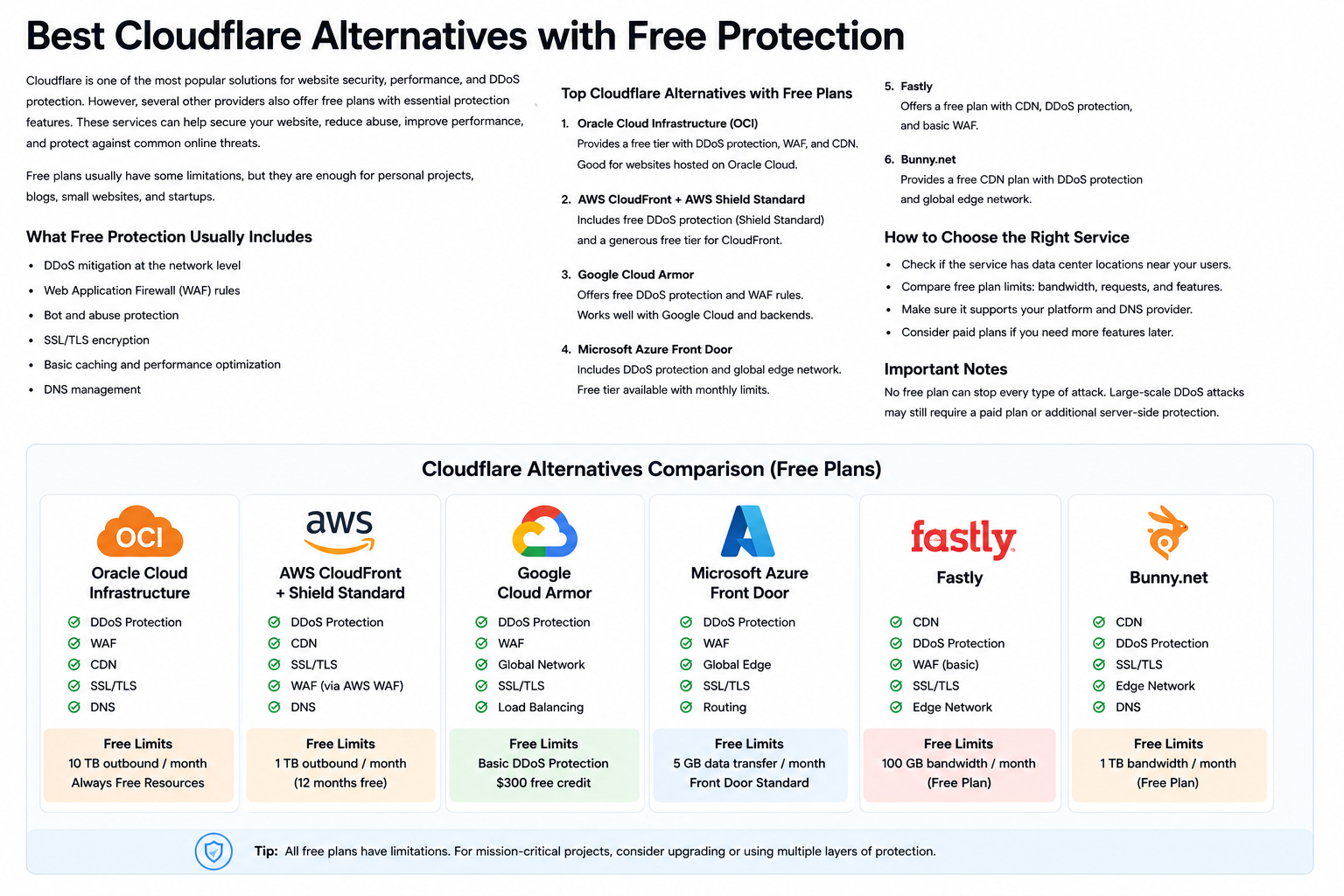
Free and Low-Cost Services Similar to Cloudflare for Website Protection
Cloudflare is one of the most popular services for protecting websites from DDoS attacks, bots, and unwanted traffic. It combines CDN, DNS, SSL, caching, and security features in one platform. However, it is not the only option. There are several similar services that can help protect a website for free or with a limited free plan.
Free protection usually has limits. Some services offer a permanent free plan, while others provide a trial period or free usage within certain traffic limits. For small websites, blogs, landing pages, and personal projects, these options can still be very useful.
Why Use a Cloud Protection Service
A cloud protection service sits between visitors and your server. Instead of sending all traffic directly to your hosting account, visitors first connect to the protection provider. The provider filters suspicious traffic, absorbs some attacks, caches content, and sends clean traffic to your origin server.
- Hides the real server behind a proxy layer.
- Reduces load with CDN caching.
- Filters some malicious requests before they reach the server.
- Helps protect against bots and basic DDoS attacks.
- Provides SSL and performance features.
- Improves availability during traffic spikes.
Cloudflare Free Plan
Cloudflare is still the strongest free option for many small websites. Its free plan includes CDN, DNS, SSL, and basic DDoS protection. It is easy to set up and works well for blogs, small business websites, personal projects, and simple web applications.
- Good free DDoS protection for websites.
- Free CDN and caching.
- Free SSL support.
- Easy DNS-based setup.
- Useful for small and medium websites.
Cloudflare is usually the first service to try if you need free website protection with a simple setup.
Fastly Free Tier
Fastly is a powerful edge cloud and CDN platform. It is more developer-focused than Cloudflare and gives more control over edge behavior. Fastly offers a free tier that can be useful for testing, development, personal websites, and smaller projects.
- Good for developers and technical users.
- Fast CDN and edge delivery.
- Useful for static sites and web applications.
- Free tier available for testing and smaller usage.
- More flexible, but also more complex than basic tools.
Fastly is a good choice if you want more control and are comfortable with a more technical platform.
Gcore CDN Free Plan
Gcore provides CDN, edge, and DDoS-related services. Its CDN has a free plan with a traffic limit, which can be useful for small websites and projects that need basic acceleration and some protection from traffic spikes.
- Free CDN plan available with usage limits.
- Global edge network.
- Can help reduce load on the origin server.
- Useful for static content and small websites.
- Good option for testing an alternative to Cloudflare.
Gcore can be a practical option if you want CDN protection and performance features without immediately paying for a large plan.
AWS Shield Standard
AWS Shield Standard is included automatically for AWS customers. It helps protect AWS-hosted applications from common network and transport-layer DDoS attacks. It is especially useful when combined with services such as Amazon CloudFront and Route 53.
- Included for AWS customers at no additional charge.
- Protects against common network-level DDoS attacks.
- Works well with CloudFront and Route 53.
- Good for websites already hosted on AWS.
- Not a general free service for non-AWS servers.
AWS Shield Standard is not a direct Cloudflare replacement for every website, but it is a valuable free baseline if your infrastructure is already on AWS.
Bunny CDN Free Trial
Bunny is a fast and affordable CDN platform with security features and DDoS protection included in its network. It is not usually positioned as a permanent free service, but it offers a free trial, which can be useful for testing performance and protection before paying.
- Fast CDN with simple pricing.
- DDoS protection included as part of the platform.
- Free trial available.
- Good for performance-focused websites.
- Useful if you want a low-cost alternative after the trial.
Bunny is a good option for users who want something cheaper and simpler than many enterprise CDN platforms.
Imperva Free Trial
Imperva is a more enterprise-oriented security provider. It offers website protection, CDN, WAF, and DDoS mitigation features. Its free option is usually a trial rather than a permanent free plan.
- Strong website and application protection.
- Includes WAF and DDoS mitigation features.
- Better suited for business and enterprise websites.
- Free trial available.
- Usually more expensive than basic CDN services.
Imperva is worth considering if your project needs stronger business-grade security and you are ready to move beyond free plans.
Which Free Option Should You Choose
The best choice depends on your website, hosting setup, traffic level, and technical skills. For most small websites, Cloudflare is the easiest free starting point. For developers, Fastly can be more flexible. For CDN testing with free traffic limits, Gcore is a strong option. For AWS-hosted projects, AWS Shield Standard is already included.
- Best simple free option: Cloudflare.
- Best for developers: Fastly.
- Best CDN alternative with free limits: Gcore.
- Best for AWS-hosted websites: AWS Shield Standard.
- Best low-cost trial option: Bunny.
- Best enterprise trial option: Imperva.
Important Limitations
Free protection is useful, but it is not unlimited. Free plans may have fewer firewall rules, less support, fewer advanced bot controls, limited analytics, or traffic limits. Some services are free only during a trial period.
- Free plans may have feature limits.
- Advanced WAF rules may require payment.
- Enterprise support is usually not included.
- Some services offer only a free trial.
- Large attacks may require paid protection.
- Origin server security is still important.
Best Practices
- Hide the real origin IP when possible.
- Use CDN caching for public content.
- Enable SSL and redirect traffic to HTTPS.
- Restrict direct access to the origin server.
- Monitor traffic and security events.
- Use strong passwords and keep the server updated.
- Combine cloud protection with local firewall rules.
- To check the reliability of your own DDoS protection, you can buy ddos attack.
Conclusion
Cloudflare remains one of the best free services for basic website protection, but it is not the only option. Fastly, Gcore, AWS Shield Standard, Bunny, and Imperva can also be useful depending on the project.
For a small website, a free CDN and DDoS protection layer can greatly improve reliability. For larger or business-critical projects, free protection should be treated as a starting point, not a complete security strategy.
The strongest approach is layered: use a cloud protection service, keep the origin server secured, enable caching, monitor traffic, and prepare a plan for larger attacks.