IELTS Academic Writing Task 1/ Graph Writing – Tables:
You should spend about 20 minutes on this task.
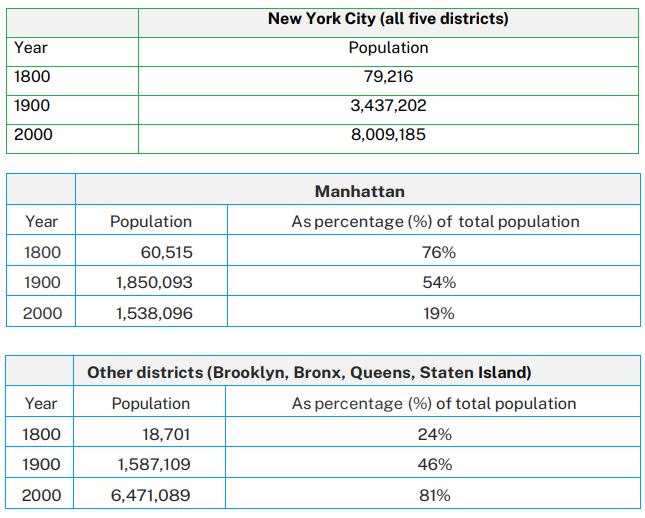
The first table below shows changes in the total population of New York City from 1800 to 2000. The second and third tables show changes in the population of the five districts of the city (Manhattan, Brooklyn, Bronx, Queens, Staten Island) over the same period.
Summarise the information by selecting and reporting the main features, and make comparisons where relevant.
Write at least 150 words.
Model Answer:
The tables provide information about the total population of New York City in 1800, 1900 and 2000, as well as the population distribution between Manhattan and the other four districts over the same period.
Overall, the population in New York City dramatically increased over the two centuries. At the same time, the population distribution in Manhattan in 1800 and 1900 was much higher, but became far less concentrated in 2000, with the other four districts accounting for an increasingly large proportion of residents by 2000.
In 1800, the total population of New York City was relatively small, at around 80 thousand. By 1900, this number rose sharply to nearly 3.5 million, and it more than doubled again to reach over 8 million in 2000.
A closer look at the population distribution in five districts of this city reveals a clear shift. In 1800, Manhattan’s population was more than 60 thousand, representing slightly more than two-thirds of the total population. The other districts combined accounted for only 18,000 residents or just 24%. By 1900, although Manhattan’s population grew significantly to more than 1.8 million, its share of the total population declined to 54%, while the other four districts’ share of the population increased to 46%. By 2000, Manhattan’s population had declined slightly to 1.5 million, reducing its share to just 19% of the total. In contrast, the combined population of Brooklyn, the Bronx, Queens and Staten Island surged to much higher than 6.4 million, accounting for a dominant 81%.