IELTS Academic Writing Task 1/ Graph Writing – Pie Charts:
You should spend about 20 minutes on this task.
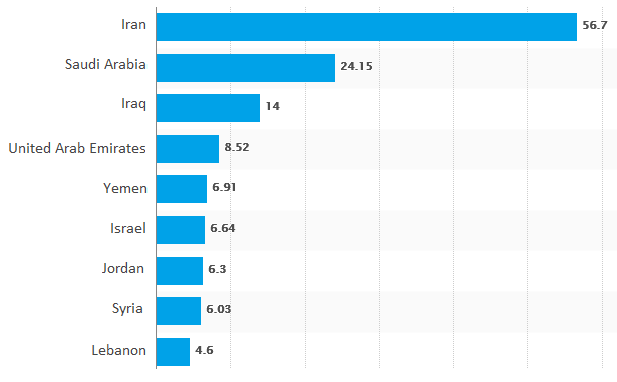
The chart below shows the internet users (in millions) in different countries in the Middle East as of June 2017.
Summarise the information by selecting and reporting the main features, and make comparisons where relevant.
You should write at least 150 words.
Internet users in millions – June 2017
Model Answer 1:
The bar chart depicts the number of internet users across nine Middle Eastern countries as of June 2017.
Overall, there was a stark disparity in digital penetration in this region. Iran stood out dramatically with the highest number of users, while Lebanon had the lowest internet subscribers during this time.
In detail, Iran led the list of the highest number of internet users in June 2017 by a wide margin among the nine Middle Eastern countries. This country had more than 56 million users back then. Saudi Arabia followed in the second place with over 24 million internet subscribers, while Iraq came third with exactly 14 million netizens. The United Arab Emirates (UAE) had a relatively modest figure of 8.52 million internet users, putting it squarely in the mid-range. The remaining countries, i.e. Yemen, Israel, Jordan, and Syria, all had similar figures in terms of total internet users, each hovering around 6 to 7 million. On the other end of the range, Lebanon has the smallest number, with just 4.6 million people using the internet.
Model Answer 2:
The bar chart outlines the number of internet users in nine Middle Eastern countries as of June 2017. A glance at the bar chart reveals that Iran had by far the highest internet users, while it was the lowest in Lebanon.
The diagram outlines that more than 56 million Iranian citizens were connected to the internet in June 2017, which was the highest in number among the nine countries. During that time, Saudi Arabia had the second-highest number of netizens, citizens who use the internet, whereas more than 24 million citizens had access to the internet. Iraq, with exactly 14 million internet subscribers, was in a distant third, while internet users in the United Arab Emirates were roughly eight and a half million. The number of citizens who had internet connections in countries like Yemen, Israel, Jordan and Syria was somewhat 6 million each. Finally, with the least number of internet users (4.6 million), Lebanon stood at the bottom of the list.
Sample Answer 3:
The bar graph reveals the number of internet users in June 2017 in nine different countries in the Middle East. As a general trend, Iran and Saudi Arabia had far more internet users than the remaining countries in this region.
According to the diagram, among the Middle Eastern countries, Iran had the highest number of internet users in June 2017, which was well over 56 million. With more than 24 million internet subscribers, Saudi Arabia held the second position. Besides, 14 million Iraqis were connected to this digital world, which was significantly fewer than that of Iranian and Saudi Arabian internet users, but notably higher than that of most other Arab countries. Interestingly, Yemen, Israel, Jordan and Syria had a similar number of internet subscribers, which ranges from approximately 6 to 7 million. Finally, in the United Arab Emirates, just over 8.5 million citizens had access to the internet in June 2017, and the lowest number of internet users in a country was from Lebanon, where fewer than 5 million people had access to the internet.
The bar graph sheds light on the percentage of netizens present in each country of the Middle East in the year of 2017. The number of internet users is given in million.
It is evident that Iran constituted the highest number of internet users while Lebanon had the least. Remaining countries were in their subsequent positions in the year 2017.
In details, among the given Middle Eastern countries, Iran had the maximum number, 56.7 million, internet users. Saudi Arabia with 24.15 million and Iraq with 14 million netizens stood in the second and third places respectively. Surprisingly, Yemen, Israel, Jordan and Syria were in close quarters to each other occupied by a little over 6 million users of this technology. The least internet-dependent country was Lebanon, where only 4.6 million people had access to the internet. And the United Arab Emirates had double the number of internet users than that of Lebanon in this year.
Hi, with regard to the writing task 1 sample- “The chart below shows the internet users (in millions) in different countries in the Middle East as of June 2017.”, the model answer shows the data as percentages while the title shows the numbers as millions (population). I’m confused.