IELTS Academic Writing Task 1/ Graph Writing – Pie Charts:
You should spend about 20 minutes on this task.
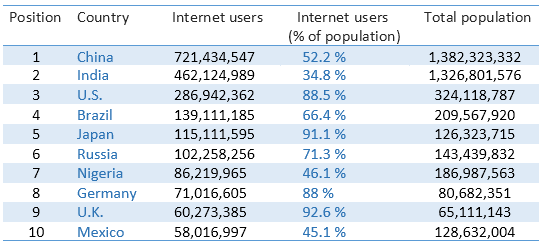
The table data below shows the top ten Internet users by country in 2016.
Summarise the information by selecting and reporting the main features, and make comparisons where relevant.
You should write at least 150 words.
Model Answer 1:
The table ranks the top ten countries by number of internet users in 2016, presenting both absolute user figures and the proportion of the population connected online.
Broadly speaking, populous nations such as China and India dominated the list in sheer volume, whereas smaller or more developed countries like the UK and Japan boasted the highest digital penetration rates in 2016.
In detail, China led the list by a significant margin, with over 721 million internet users, comprising just over 52% of its total population. India followed in second place with 462 million users, but this represents only about 35% of its much larger population. Meanwhile, the United States had 286 million active internet users (third in absolute terms), but had one of the highest rates of population with internet access. In the USA, almost nine in every ten people had access to the internet, indicating near-universal access.
Looking further down the list, Brazil, Japan, and Russia each report over 100 million internet users, but with vastly different ratios of population access: Japan stands out with an impressive 91% of its population online. Germany, the UK, and Mexico round out the top ten, with the UK achieving the highest usage ratio at 92.6%, despite having a lower total number of users than countries like Brazil.
Sample Answer 2:
The table data lists the top ten countries in the world with the highest number of internet users in the year 2016. It shows the number of people with access to the internet, the total population of the country and the percentage of people with internet access as of 2016.
Overall, China had the highest internet users, while the UK and Japan had the highest ratio of internet users.
As is signified in the illustration, the population of China in 2016 was over 1.3 billion, and more than half of them had access to the internet. In terms of the number of internet users, China stood at the top of the list, whereas India and the USA held the second and third positions respectively, with over 462 million and 286 million internet users. Though India’s population was more than 1.3 billion, only one-third of them were connected to the internet, unlike the USA, where almost nine out of ten citizens used the internet. Brazil, Japan and Russia, with more than 100 million netizens (citizens who are connected to the internet), stood fourth to sixth positions respectively. The UK and Mexico were at the bottom of the list with around 60 million netizens. However, the internet users’ ratio in the UK was the highest, over 92% while it was the second-highest in the USA.
It would be best if you had an overview paragraph after the Introduction. A conclusion is not necessary.
My teacher told me that four body paragraphs are good to achieve high bands in IELTS. Introduction, BP(1), BP(2) and Conclusion. But I am confused after reading this pattern with two body paragraphs. Is it fine to copy this pattern?