IELTS Academic Writing Task 1/ Graph Writing – Diagram / Process Diagram:
You should spend about 20 minutes on this task.
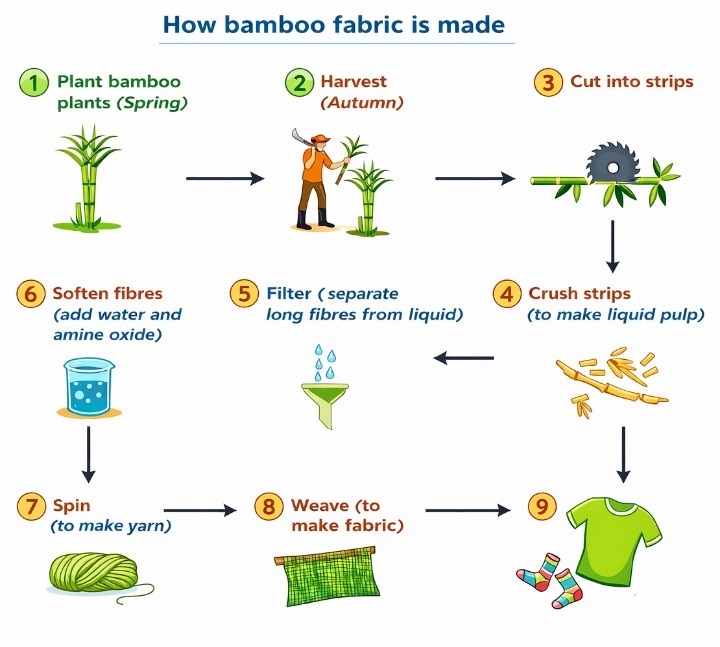
The diagram below shows how fabric is manufactured from bamboo.
Summarise the information by selecting and reporting the main features, and make comparisons where relevant.
Write at least 150 words.
Model Answer 1:
The diagram illustrates the process of producing fabric from bamboo, outlining a sequence of nine stages from cultivation to the final textile products.
Overall, the procedure involves three main phases: growing and harvesting bamboo, converting the raw material into fibres through mechanical and chemical treatment, and finally transforming these fibres into fabric.
In the initial stage, bamboo is planted in spring and later harvested in autumn once it has matured. The harvested bamboo is then cut into strips, which are subsequently crushed to produce a liquid pulp. This pulp undergoes filtration, where the long fibres are separated from the liquid.
Following this, the extracted fibres are softened by adding water and amine oxide, a chemical that helps break down the material and prepare it for further processing. Once softened, the fibres are spun into yarn, marking the transition from raw material to textile form. In the final stages, the yarn is woven into fabric, which can then be used to produce finished goods such as clothing items and socks.
Sample Answer 2:
The diagram outlines the different stages of manufacturing textile fabrics from bamboo trees, starting with the plantation of bamboo up until making textile items, like t-shirts and socks.
Overall, fabric manufacturing from bamboo involves nine stages in total, but they are broadly divided into three main stages: plantation and harvesting of bamboo, fibre production, and manufacturing.
In detail, bamboo is planted in the spring, and farmers harvest it in the autumn. The bamboo plants are then cut into strips using cutting machines, and further crushed to make liquid pulp. This liquid pulp is then filtered to separate long fibres from any remaining liquid. Water and amine oxide are then mixed with the filtered pulp to soften it. This stage is important for softening the produced fibre. In the next stage, the fibres are spun to make yarn. The produced yarn is then woven to make fabrics, which are then used to produce textile products like t-shirts, socks, and so on.