IELTS Academic Writing Task 1/ Graph Writing – Diagram:
You should spend about 20 minutes on this task.
The diagrams below show the life cycle of a species of large fish called the salmon.
Summarise the information by selecting and reporting the main features, and make comparisons where relevant.
Write at least 150 words.
Model Answer 1:
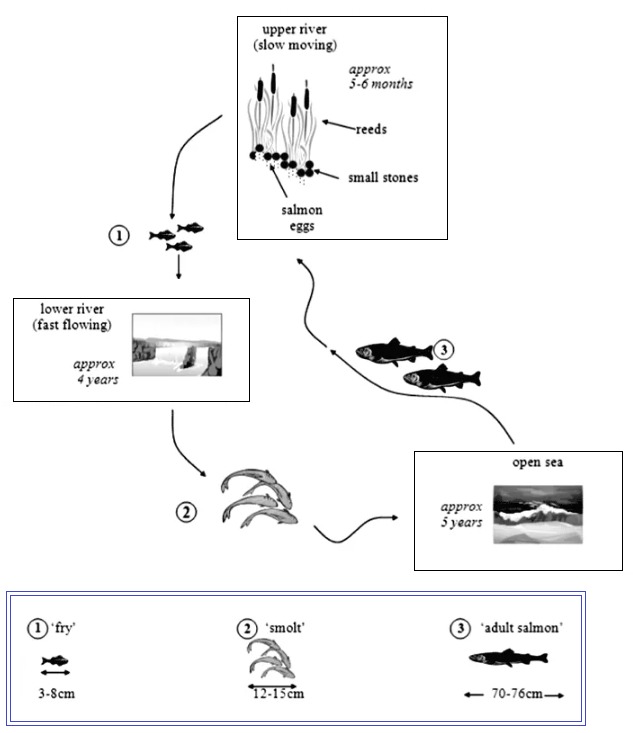
The diagrams illustrate the life cycle of the salmon, a large fish species that undergoes three major stages of development in distinct aquatic environments, namely: river, estuary, and open ocean.
Overall, salmon progress from eggs laid in slow-moving upper-river streams to mature adults living in the ocean before eventually returning to their place of origin to reproduce, and the whole process takes approximately 9 years. The cycle is characterised by changes in size, habitat and behaviour.
As the diagram suggests, the lifecycle of salmon begins in the upper reaches of rivers, where eggs are deposited among small stones and reeds. After roughly five to six months, the eggs hatch into fry, which are small fish of approximately 3 to 8 centimetres in length. At this stage, they gradually migrate downstream, where the current is fast-flowing.
As the fry grow into smolt, typically reaching a size of 12 to 15 centimetres, they move into the estuary. This transitional environment allows them to adapt to saltwater conditions. They spend a period of maturation here before entering the open sea. In the ocean, salmon reach full adulthood, growing significantly larger, often around 70 to 76 centimetres. They remain in this habitat for approximately 5 years, feeding and developing the energy reserves needed for their return journey. Eventually, the mature adults swim back upstream to the calm freshwater environment where they originally hatched, completing the cycle by laying eggs and restarting the process.
Model Answer 2:
The diagrams illustrate the life cycle of a salmon fish, showing its progression from egg to mature adult across different habitats.
As the diagram shows, salmon undergo four main developmental stages: egg, fry, smolt, and adult, and spend their early life in freshwater before migrating to the ocean. Once fully grown, they return to the river to reproduce and begin the cycle anew.
In detail, salmon begin their life in the upper reaches of a river, where adult fish lay eggs among small stones and reeds in slow-moving water. After approximately five to six months, the eggs hatch into fry, which measure around 3–8 cm. The fry gradually swim downstream into faster-flowing stretches of river, where they live and grow for about four years. During this period, they develop into smolt, reaching a length of 12–15 cm. From there, they move into the open ocean, where they spend approximately five years growing into adult salmon, typically attaining a size of 70–76 cm. Finally, once they reach full maturity, adult salmon return to the river to spawn, laying eggs among the stones and reeds where their life began, thus completing the cycle.