IELTS Listening Sample 50
You will hear a number of different recordings, and you have to answer questions on what you hear. There will be time for you to read the instructions and questions and you will have a chance to check your work.
All the recordings will be played once only. The test is in 4 Parts. At the end of the test, you will be given 10 minutes to transfer your answers to an answer sheet.
Listening Audio: [Click on the Play button to start the recording.]
Section 1: Questions 1–10
Questions 1–6
Complete the form below.
Write NO MORE THAN THREE WORDS AND/OR A NUMBER for each answer.
HOMESTAY APPLICATION
Example
Surname: …… Yuichini ……
First name: 1 ………………..
Sex: female
Nationality: Japanese
Passport number: 2 ………………..
Age: 28 years
Present address: Room 21C, Willow College
Length of homestay: approx 3 ………………..
Course enrolled in: 4 ………………..
Family preference:
no 5 ………………..
no objection to: 6 ………………..
Questions 7–10
Answer the questions below.
Write NO MORE THAN TWO WORDS for each answer.
7. What does the student particularly like to eat? ………………..
8. What sport does the student play? ………………..
9. What mode of transport does the student prefer? ………………..
10. Where will the student find her homestay address? ………………..
Section 2: Questions 11–20
Questions 11–14
Choose the correct letter, A, B or C.
11. What kind of tour is Sally leading?
A. a bus tour
B. a train tour
C. a walking tour
12. The original buildings on the site were
A. houses
B. industrial buildings
C. shops
13. The local residents wanted to use the site for
A. leisure
B. apartment blocks
C. a sports centre
14. The Tower is at the centre of the
A. nature reserve
B. formal gardens
C. Bicentennial Park
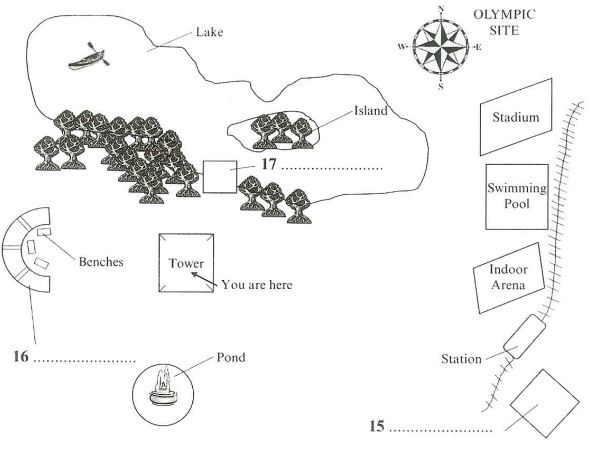
Questions 15–17
Label the plan below.
Write NO MORE THAN TWO WORDS for each answer.
Questions 18–20
Complete the table below.
Write NO MORE THAN TWO WORDS for each answer.
Nature Reserve
| Area | Facility | Activity |
|---|---|---|
| The Mangroves | boardwalk | 18 ……………….. |
| Frog Pond | outdoor classroom | 19 ……………….. |
| The Waterbird Refuge | 20 ……………….. | bird watching |
Section 3: Questions 21–30
Questions 21–22
Complete the sentences below.
Write NO MORE THAN ONE WORD AND/OR A NUMBER for each answer.
The presentation will last 15 minutes.
There will be 21 ……………….. minutes for questions.
The presentation will not be 22 ………………..
Questions 23–26
What do the students decide about each topic for the geography presentation?
Choose the correct letter, A, B or C.
A. They will definitely include this topic.
B. They might include this topic.
C. They will not include this topic.
23. Geographical location ………………..
24. Economy ………………..
25. Overview of Education System ………………..
26. Role of English Language ………………..
Questions 27–30
Complete the table below.
Write NO MORE THAN TWO WORDS for each answer.
| Information / Visual aid | Where found? |
|---|---|
| Overhead projector | the 27 ……………….. |
| Map of West Africa | the 28 ……………….. |
| Map of the islands | a tourist brochure |
| Literacy figures | the 29 ……………….. |
| 30 ……………….. on school places | a brochure |
Section 4: Questions 31–40
Questions 31–33
Choose the correct letter, A, B or C.
Monosodium Glutamate (MSG)
31. The speaker says the main topic of the lecture is
A. the history of monosodium glutamate.
B. the way monosodium glutamate works.
C. where monosodium glutamate is used.
32. In 1908, scientists in Japan
A. made monosodium glutamate.
B. began using kombu.
C. identified glutamate.
33. What change occurred in the manufacture of glutamate in 1956?
A. It began to be manufactured on a large scale.
B. The Japanese began extracting it from natural sources.
C. It became more expensive to produce.
Questions 34–40
Complete the notes below.
Write NO MORE THAN TWO WORDS for each answer.
| Monosodium Glutamate (MSG)
• MSG contains: • Glutamate is found in foods that contain protein such as 35 ……………….. and 36 ……………….. • MSG is used in foods in many different parts of the world. • In 1908 Kikunae Ikeda discovered a 37 ……………….. . • Our ability to detect glutamate makes sense because it is so 38 ……………….. naturally. • John Prescott suggests that: |
[Source: Cambridge IELTS Book 7]
Answer: Click the button to Show / Hide Answers