IELTS Academic Writing Task 1/ Graph Writing – Table:
You should spend about 20 minutes on this task.
The table below shows average hours and minutes spent by UK males and females on different daily activities.
Summarise the information by selecting and reporting the main features, and make comparisons where relevant.
You should write at least 150 words.
Model Answer 1:
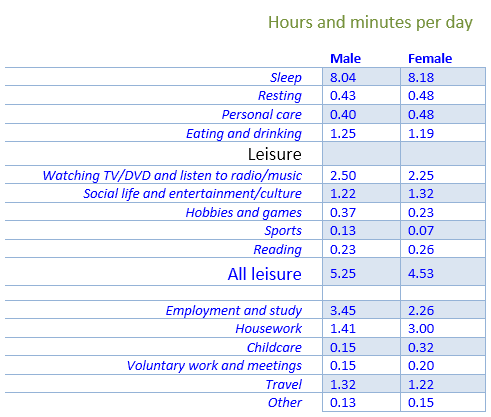
The table data compares the average number of hours and minutes per day that UK men and women devote to various daily activities, including leisure, rest, professional work and childcare.
In general, sleeping and resting take up the largest part of both genders’ day, while significant gender differences emerge in housework, childcare, and work/study time. Women spend substantially more time on domestic duties, whereas men dedicate more time to employment or academic activities.
More precisely, both men and women in Britain average just over eight hours of sleep, with women resting slightly longer than men. In the category of personal care, women again spend more time than men, 48 minutes compared to 40 minutes. Men spend about 1 hour and 25 minutes eating and drinking, slightly more than women.
When it comes to leisure, men enjoy approximately 5 hours 25 minutes per day, whereas women have around 4 hours 53 minutes. A large portion of this leisure time is dedicated to watching TV, listening to music, or similar passive activities. In terms of professional or academic engagement, men spend around 3 hours and 45 minutes daily, significantly more than women.
On the other hand, women commit about 3 hours per day to housework, which is nearly twice as much time as men, who spend around 1 hour 41 minutes on this. In childcare, women again spend more (around 1 hour 11 minutes) compared to men’s roughly 41 minutes. Volunteering and meetings also take more of women’s time than men’s. In daily travel, men travel slightly longer than women in Britain.
Model Answer 2:
The table data illustrates how much time average British males and females spend on various daily activities. It is apparent that sleeping consumes the highest duration of their time, while leisure and professional activities involve a notable portion of their days. Moreover, females do more housework and child-rearing tasks than males do on a daily basis.
As can be seen, an average British male sleeps and rests just about 8 and a half hours a day, while females’ sleeping and resting time is half an hour more than that. Males in Britain spend just 40 minutes on their personal care, while it is slightly more for females. Furthermore, a male takes an hour and twenty-five minutes to enjoy their meals each day, while it is 6 minutes shorter for their female counterparts.
Looking further, men spend 5 hours and 25 minutes to enjoy their leisure activities, while it is around 28 minutes less for females. Watching TV and enjoying music is a popular pastime among the British, as they spend over half of their leisure time on that. They spend less time reading or participating in sports than they do watching TV and listening to music.
Men spend 3 hours and 45 minutes a day on professional and academic purposes, more than females’ involvement in this. However, females devote more time to household work, childcare and voluntary work, roughly 4 hours, compared to almost half of that by men. Finally, British people travel for nearly 1 and a half hours daily, and men employ slightly more time doing it than that of females.
The presented table expresses the number of hours and minutes that males and females in the UK invest in their daily activities.
As is observed, sleeping is an activity that reserves a large amount of time. The time spent on housework is also interesting, because of the differences that males and females present in the time they dedicate to that.
To begin with, both males and females consider sleeping an important part of their daily routine. Consequently, they spend more than 8 hours a day on this activity. The difference is slightly small, almost 15 minutes higher for British women. Not surprisingly, as the table suggests, the time that females invest doing housework is more than double the time that males spent on the same activity. So, while females spend 3 hours per day on such housework, males did so for only 1 hour and 40 minutes per day.
Moreover, men spend more time on their jobs and studies which is 3.45 hours per day, and it is just over 2 hours for females. If we compare the total leisure hours spent by males and females, it is apparent that males have almost 5 and a half hours for that while it is just below 5 hours for females. Finally, childcare is also a task that engages more time for females in the UK than males.
The table illustrates the gender-wise amount of time the British spent on various everyday activities.
Overall, the British, irrespective of gender, spent the most time sleeping. Also, while men spent significantly more time on employment and study than women, the trend was the opposite for housework.
It is noticeable that both the men and women spent the most amount of time, at just over 8 hours, sleeping. This was followed by spare time activities for which they spent about 5 hours. Among the leisure activities, both the genders spent the most on “watching TV/DVD and listening to music” – at 2 hours 50 minutes and 2 hours 25 minutes respectively.
Meanwhile, men spent considerably more on jobs and studies than women at 3 hours 45 minutes to only 2 hours 26 minutes accounting for a gender-wise difference of 79 minutes. By contrast, women spent 79 minutes more than men on housework at 1 hour 45 minutes to 3 hours. Besides, both genders also spent over 1 hour on “eating and drinking” and travelling.