IELTS Academic Writing Task 1/ Graph Writing – Bar Chart/ Column Graph:
You should spend about 20 minutes on this task.
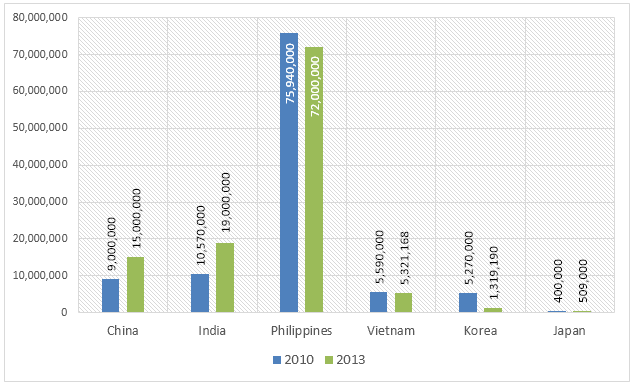
The graph below gives information about the number of Catholics residing in different nations, from 2010-2013.
Summarise the information by selecting and reporting the main features, and make comparisons where relevant.
You should write at least 150 words.
Estimated number of Catholics per nation
Model Answer 1:
The column chart compares the number of Catholics in six different nations in Asia between 2010 and 2013.
Overall, the Philippines had by far the largest Catholic population in both years, despite experiencing a slight decline. In contrast, the number of Catholics in China and India increased substantially over the period, while their number decreased in Vietnam and South Korea.
In 2010, the Philippines had roughly 76 million Catholics – a significantly higher Catholic population than the five other countries. By 2013, this number had dropped slightly to around 72 million, although the Philippines remained the clear outlier. In India and China, however, their number witnessed significant rises. India’s Catholic population grew from about 10.5 million to 19 million, while China’s figure increased from around 9 million to 15 million.
Meanwhile, Vietnam and South Korea experienced declining numbers of their Catholic population. Vietnam’s total number fell marginally over the three years, whereas South Korea saw a more noticeable drop. Japan, which had the smallest Catholic population at about 0.4 million in 2010, rose slightly to roughly 0.5 million in 2013, maintaining its position as the least populated Catholic community among the six nations.
Model Answer 2:
The column graph illustrates the number of Catholics in six Asian countries, comparing their numbers in 2010 and in 2013.
In general, the highest number of Catholic believers was in the Philippines. Their numbers increased in China and India, while the opposite was true for Vietnam and Korea.
As the data suggests, almost 76 million Catholics resided in the Philippines in 2010, making it the highest number among the six given countries. All five other countries did not even have half of this figure combined in 2010. After three years, the Catholic population in the Philippines decreased by 4 million, still remaining staggeringly higher than all other countries combined. The second-highest Catholic population – 10.5 million – resided in India in 2010. This number was exactly 9 million in China at that time. After three years, the number of Catholics in India and China increased significantly. China witnessed a 6 million increase, and India’s Catholic population almost doubled.
On the contrary, Vietnam observed a slight decrease in their Catholic population, which dropped to approximately 5.3 million in 2013 from the initial figure of roughly 5.6 million. Korea witnessed the greatest decline in its Catholic population, which dropped to just over 1.3 million in 2013 from 5.2 million three years earlier. Finally, Japanese Catholics were the smallest in number and did not change much during the period. Their number hovered around 0.4 to 0.6 million.
Sample Answer 3:
The column graph enumerates the number of Catholic residents in six different countries between 2010 and 2013.
A glance at the graph reveals that the Philippines, among the given countries, had the highest number of Catholics during 2010 and 2013.
It can be clearly observed that approximately 76 million Catholics stayed in the Philippines in 2010, and this number reduced after three years to nearly 72 million. It is worth noticing that the number of Catholics in the Philippines was significantly higher than in any other country. In fact, Catholics in China, India, Vietnam, Korea and Japan cumulatively made a figure which was less than half of the total Catholics in the Philippines in both years.
Looking further, 9 million Chinese nationals were Catholics, while this number was 1.5 million higher in India in 2010. The number of Catholic residents in China and India improved substantially, by 6 and 9 million, unlike in Vietnam, Korea and the Philippines, where their number actually dropped. Vietnam and Korea each had around 5 million Catholic residents in 2013, while the number of Vietnamese Catholics dipped marginally. Interestingly, it was a dramatic dip in Korea where their number declined from nearly 5.2 million to just over 1.3 million. The least number of Catholics resided in Japan, roughly 0.4 to 0.6 million, in both these years.
The given bar chart presents data on the number of Catholic residents in 6 countries (China, India, Philippines, Vietnam, Korea and Japan) in 2010 and 2013.
Overall, it is obvious that the Philippines had the largest figure in terms of the Catholic population, which was significantly higher than all the other five countries. Moreover, the total population of this creed increased in China and India while decreased in the Philippines and Korea.
As mentioned, with over 70 million Catholic residents, the Philippines stood on the top of the list, despite a drop of almost 4 million after three years. The data also suggests that there was a considerable rise in the number of Catholics in China and India, as their figures almost doubled after 3 years. In 2013, China and India had 15 and 19 million Catholic residents, respectively.
Additionally, Vietnam and Korea had slightly over 5 million Catholics in 2010. While Vietnam saw a slight decrease after 3 years, Catholic residents in Korea dipped to one-fourth. The country that had the lowest figure, Japan, had between 400 and 509 thousand Catholic residents throughout the period.